If you are an NRI living in the US, the UK, the Gulf, or Singapore, and your parents are in India, the hardest question you will ever face is this: how do you prepare for a parent emergency in India when you live abroad?
You cannot be there in person. You cannot see the loose handrail, the slippery bathroom floor, or the pillbox that hasn't been refilled. This NRI checklist is built for exactly that gap—a practical, step-by-step guide on how to prepare for a parent emergency in India from abroad, so that when something happens, someone on the ground knows exactly what to do, and you know exactly what is happening.
Your parents in India might be living in an older independent house in a city, maybe a flat in a gated community, maybe the family home in a smaller town. On the phone they always say "everything is fine." But you know there are things a phone call cannot show: the small puddle on the bathroom floor, the loose handrail at the turn of the stairs, the water they deliberately drink less of because they don't want the trouble of getting to the toilet at night.
This article is not meant to frighten you. It is a checklist you can act on today, to build the safety net on the India side before an emergency happens. Because what keeps NRI children up at night is often not the emergency itself—it is that when something happens, nobody knows what to do.
Why India Needs Its Own Preparation
The living situation for elders in India has its own specific features. Your parents may live in an older independent house where the only bathroom is upstairs; or in a new gated apartment complex where security procedures can actually slow things down in an emergency. Summer temperatures regularly cross 40°C in many parts of the country, and dehydration poses a far higher risk to older people than to younger ones. A drive to a major hospital can take 90 minutes in peak traffic in any metro. These are not theoretical risks—they shape daily decisions.
Phone check-ins do not solve these problems. What you need is structure: who is nearby, who has a key, who arrives first in an emergency, and what you can see from abroad.
Step 1: Turn the "Emergency Contact Web" from Vague into Specific
Most NRI families have vague emergency contacts: "you can ask the uncle downstairs" or "cousin lives not too far." In an emergency, vague means nothing.
Do this today: choose one person as your "first contact" in India. Not five people—one. This person can be a relative, a trusted neighbour, or a professional care manager from a care service like KushAlaya. Everyone else is backup, but first response and decisions run through one line.
Then write the following on a piece of paper (yes, paper—older people cannot always unlock a phone in time) and stick it somewhere visible at home:
- First contact's name and phone number
- Parents' family doctor's name, clinic address, and phone
- The name of the usual hospital and where the emergency entrance is
- Parents' medication list (including doses) and allergies
- Your overseas phone number (clearly marked with time zone)
The value of this paper: when a neighbour or security guard is the first to arrive, they don't need to scroll through a phone, don't need to ask you, and don't need to guess.
Step 2: Do a Real "Remote Visibility Check"
What can you actually "see" from abroad? If all you have is the phone, your visibility is zero.
Check what tools you already have: Is location sharing turned on for your parents' phones? Do they know how to use the SOS function? If someone visits, do you receive photos or written notes?
But more important is checking the home itself. Many older houses and new apartments in India share a few easily overlooked risk points:
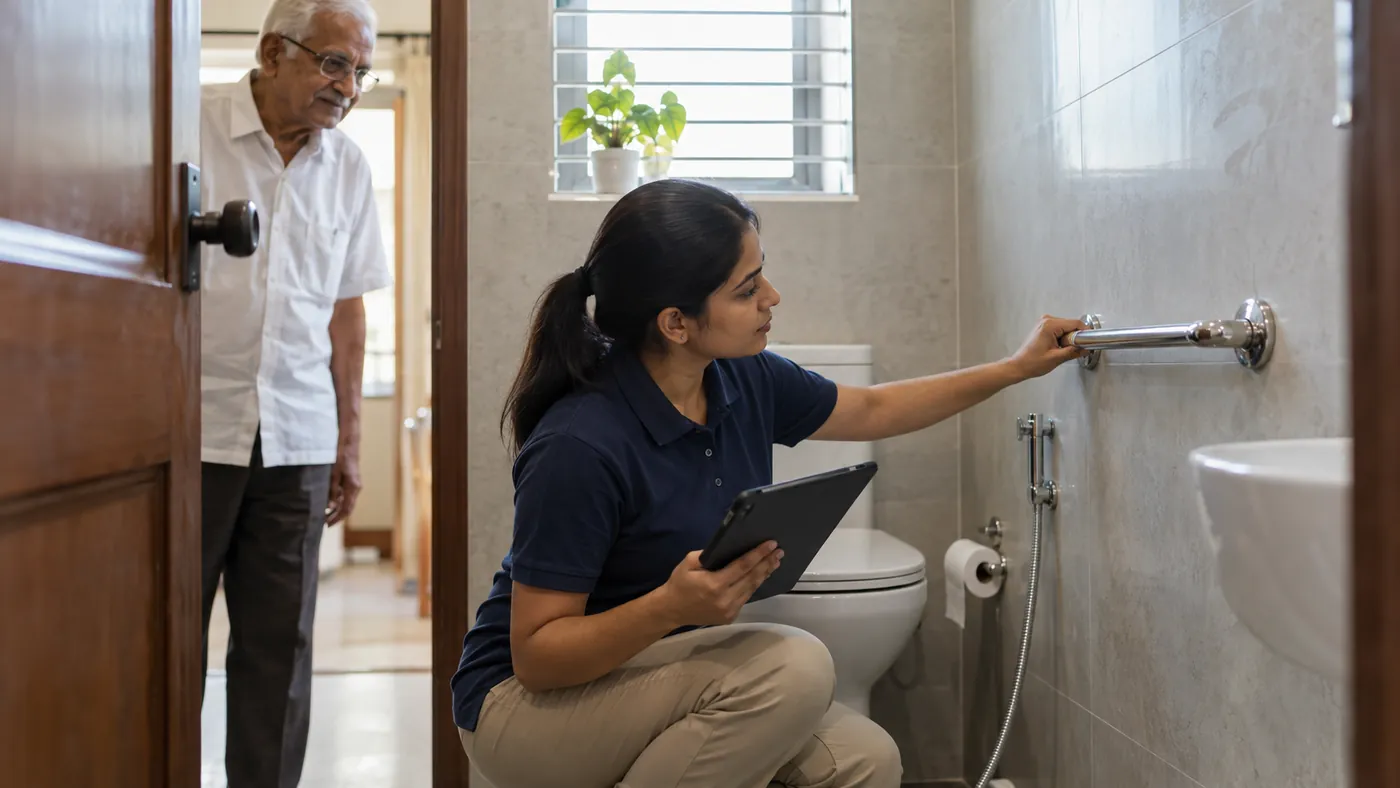
- Bathroom: Is the floor smooth marble or granite? It becomes very slippery when wet. Are there grab bars? Is there something to hold onto next to the toilet?
- Stairs: For independent houses, the outdoor staircase gets slippery in the monsoon—is the handrail secure? Is the lighting adequate?
- Drinking habits: In summer, do your parents deliberately drink less water? This is a common behaviour among older people that children rarely know about.
- Medicines: Are they taking several medicines at once? Does anyone check the pillbox regularly?
These checks don't require a medical background, but they do require someone to be there. If you can't be there, you need a reliable person to look for you—and not just a glance, but a look with a checklist.
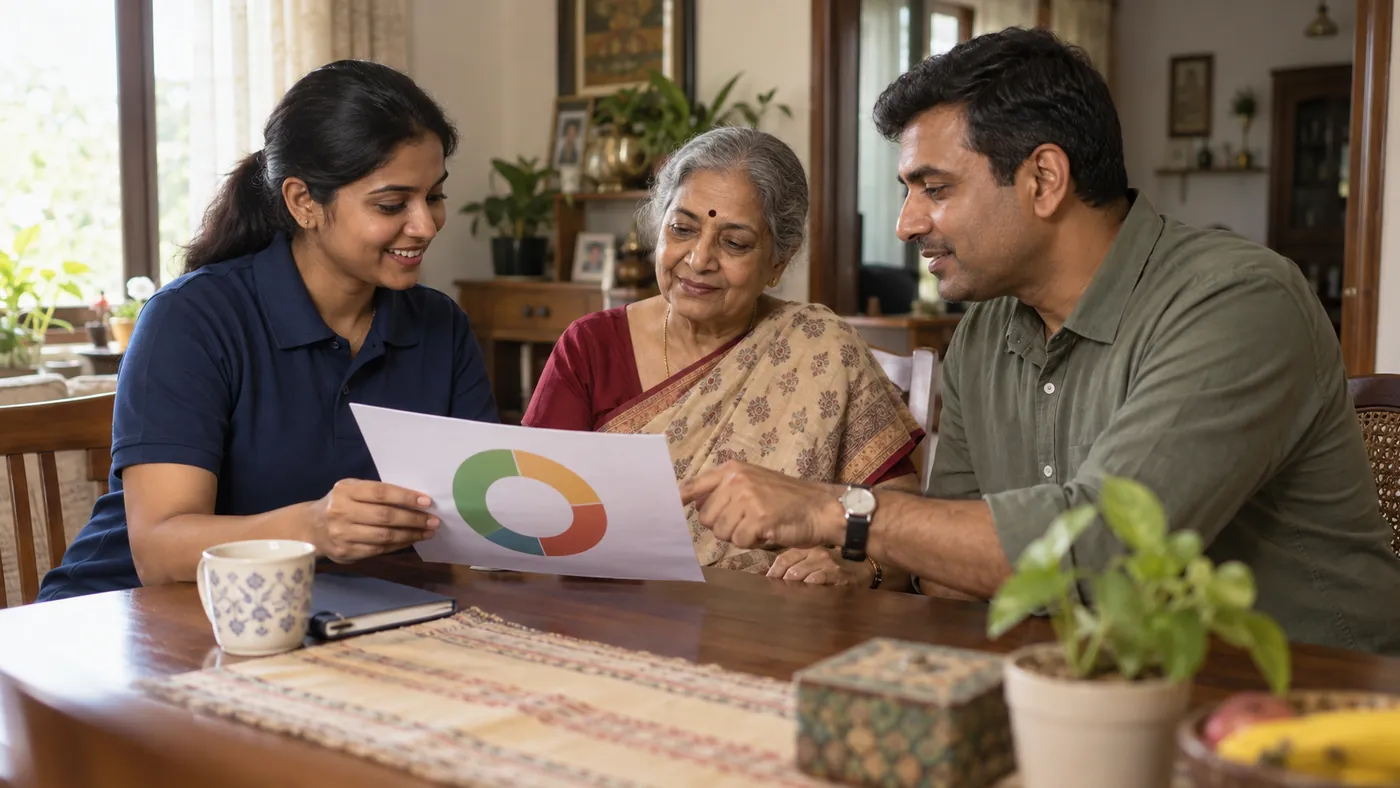
This is exactly what KushAlaya's Home Safety Assessment does: a home visit produces a Safety Score out of 100, telling you which room carries the highest risk, what needs fixing, and in what priority. The report is built for overseas children—not a vague "it's fine," but a specific score and line items.
Step 3: The "First 60 Minutes" Script for an Emergency
Assume the worst has happened: you get a call—your father slipped in the bathroom, your mother is panicking, and doesn't know what to do.
What not to do: Don't book a flight immediately. Don't call five relatives at once. Don't flood the family group chat asking "what do we do."
What to do:
Minute one: Confirm that the first contact is already on the way to your parents' home, or already there. If nobody is on-site, you need someone who can be—which is why Step 1 matters so much.
Minute ten: Have the person on-site hand the phone to the paramedic or doctor (if an ambulance has been called), or speak to you directly and tell you what they see. You need facts: is the person conscious? Where does it hurt? Can they move?
Minute thirty: Confirm which hospital. The choice depends on the injury and insurance. If the first contact can speak directly to the doctor, have them ask three questions: What tests are needed? Is admission required? What is the one thing the family needs to decide right now?
Minute sixty: If you decide to fly back, book the ticket now. Many situations become clearer within the first hour—you may not need to be there immediately, or you may. But booking before you have doctor information means you are making decisions out of panic.
This script sounds cold, but the opposite of anxiety is not indifference—it is preparedness.
Step 4: After Hospitalisation—Practical Points for Remote Coordination
If your parents need to be admitted, your role from abroad shifts from "worrying" to "remote project manager." It isn't easy, but there is a method.
Designate a local medical representative. If the first contact is willing, they can take this role: communicating with doctors, signing documents, sending you updates. If a relative isn't available, a professional care manager can fill in. The key is that this person can be present, can sign, and can relay accurate information.
Get the written discharge summary. Discharge is not the end. Indian hospitals provide a summary at discharge with diagnosis, medication, and follow-up instructions. Make sure someone photographs it and sends it to you. Many NRI children only start looking for information after their parents are discharged—by then it's too late.
Plan the first two weeks after discharge. This is the most fragile phase: Are medicines being taken on time? Is there any infection? Does someone accompany them to the follow-up? If your parents live alone, going straight home after discharge may not be the best option—at minimum, they need someone to stay overnight or visit daily for the first few days.
This is where KushAlaya's KushLife check adds value: each visit doesn't just look at "whether something went wrong," but at four things—Safe (any new risks at home), Steady (walking stability), Settled (sleep, meals, medication regularity), and Connected (what your parents want you to know, and what you want the team to look at). These check results update in the family app, so you can see them from the US or UK without waiting for a phone call.
Step 5: Build a "Daily Rhythm," Not a "Crisis Mode"
The most successful remote care for NRIs doesn't start when something goes wrong—it has a rhythm in normal times.
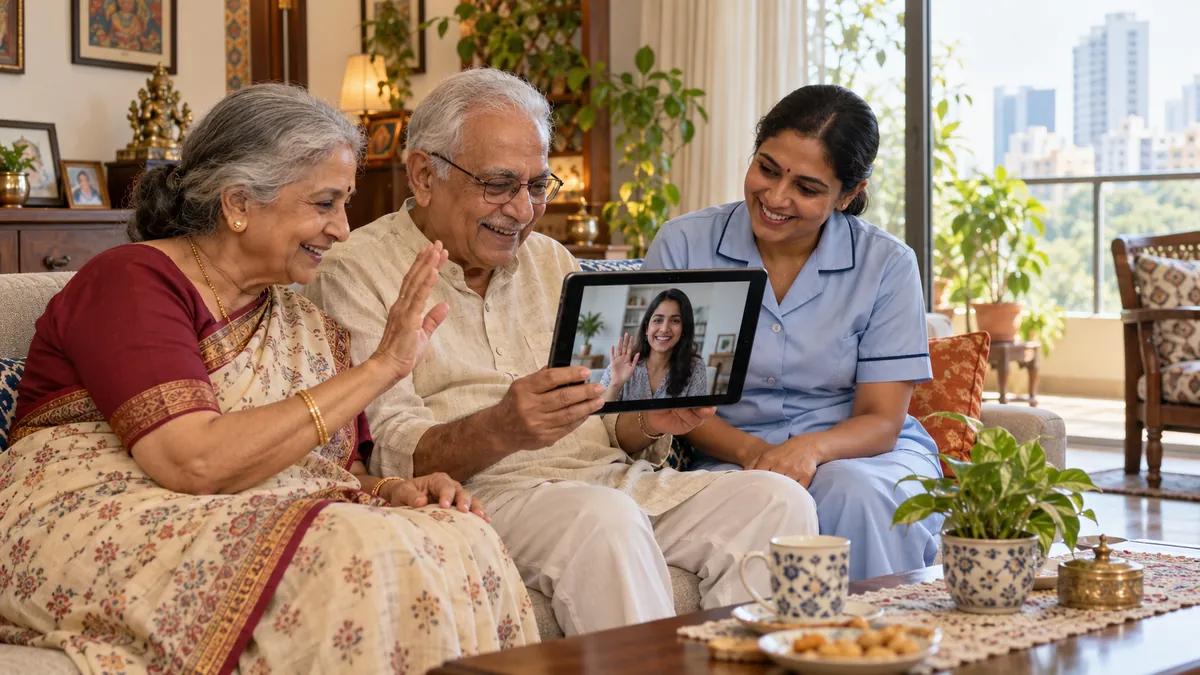
One structured call per week. Don't just ask "are you okay." Ask specifically: Has walking felt unsteady this week? Is the pillbox filled by day? How many times do you get up at night? Have you gone out? These questions surface early changes far better than "are you okay."
One home visit per month. If nobody visits regularly in India, you are essentially flying blind. The visitor doesn't need to make medical judgments—they just need to look: has anything changed at home, is there food in the fridge, how is your parents' mood. A photo and a short note are enough.
One risk review per quarter. India's seasons change the risk profile: outdoor stairs get slippery in the monsoon, dehydration risk rises in summer. A Safety Score isn't a one-time exercise—a good assessment updates with the seasons and changes in your parents' condition.
These rhythms sound like extra work, but their purpose is exactly to reduce the time you spend in random daily anxiety. You know someone is watching, you know when the next check is, you know you'll be alerted if the score drops. Anxiety shifts from "not knowing what will happen" to "knowing someone is on it."
A Checklist You Can Send Today
Copy the section below and send it to your parents or first contact, and confirm item by item:
Emergency contact information
- □ First contact's name and phone written on paper, stuck up at home
- □ Family doctor's phone confirmed
- □ Usual hospital and emergency entrance confirmed
- □ Medication list (with doses) and allergies recorded
- □ Overseas child's phone (with time zone) recorded
Home safety
- □ Is the bathroom floor non-slip? Are grab bars secure?
- □ Have stair (indoor/outdoor) handrails and lighting been checked?
- □ Is the path from bedroom to bathroom at night lit?
- □ Is there a recent professional Home Safety Assessment report?
Daily monitoring
- □ Is there a fixed weekly video/phone check-in time?
- □ Does someone visit once a month?
- □ Do your parents know how to use their phone's SOS function?
- □ Is there a pillbox organised by day?
Emergency preparedness
- □ Does the first contact have a key or a way in?
- □ Do they know to call 112 or 108 first in an emergency?
- □ Is the first two weeks after discharge planned?
If You Want Someone to "Watch" in India for You
KushAlaya started from exactly this question: when children are not nearby, who looks, who records, and who tells you what is really going on?
What we do is assessment first: a Home Safety Assessment produces a Safety Score, so you know where the risks are; then care-manager visits are arranged as needed, with four KushLife checks each time, and the results update in the family app. Whether you are in the US, the UK, or the Gulf, what you see is a concrete record, not a vague "don't worry."
If you'd like to start with a free KushCare Discovery—tell us where in India your parents live, their basic situation, and what worries you most—we will call you back and work out the next step together. No commitment to a plan, no need to decide immediately. Just a conversation that turns "I don't know where to start" into "I know what the first step is."
Your parents' home is in India. Your peace of mind can start with one assessment.